
Doorway pages and other SEO mistakes contractors make

A few common website habits work against your Google ranking instead of helping it — and a couple can get your site penalized. Doorway pages, keyword stuffing, intrusive pop-ups, and the mistakes worth knowing about.
Most contractors do not want to think about SEO. They want the phone to ring. Fair enough.
But a few common website habits actively work against that — and some of them are things contractors were told would help. Here are the ones worth knowing about, because a couple can get your site penalized by Google, not just ignored by it.
Doorway pages — the near-duplicate city pages
A doorway page is a page built mainly to catch a search and funnel the visitor somewhere else, rather than to be genuinely useful on its own. On a contractor site it is almost always a thin, near-duplicate page spun up for one more town.
Here is the pattern. A contractor wants to show up in more towns, so the site sprawls into a stack of nearly identical pages: Kitchen Remodeling in Walnut Creek, Kitchen Remodeling in San Jose, Kitchen Remodeling in Fremont — twenty of them, each a copy of the last with the city name swapped in.
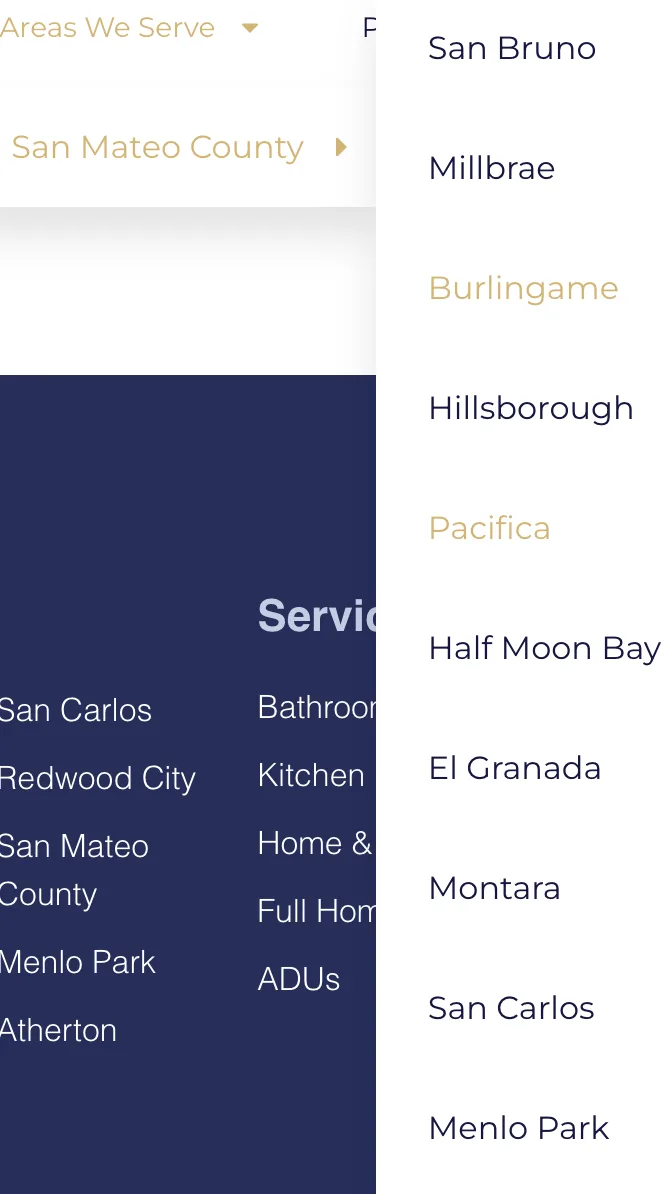
This is called a doorway page, and it does not work the way it is supposed to. Google’s spam policies name doorway pages explicitly. The search engine is good at spotting twenty pages that are really one page in twenty costumes, and the outcome is not higher rankings — it is the risk of a penalty that drags down your whole site. It is also a confusing experience for the homeowner who clicks two of them and realizes they are the same page.
The important distinction: real service-area pages are good. If you genuinely work in Walnut Creek and you build a page with actual projects you finished there, real photos, and a real description of that market, that page earns its place and helps you. The violation is not “having location pages.” It is having thin, duplicate ones with nothing unique on them but the town name.
The test is simple: if the only thing that changes between two pages is the city, you have a doorway page. If each page would still be useful to a person with the SEO stripped out, you have a real page. A handful of genuine location pages beats twenty hollow ones.
Keyword stuffing — repeating the phrase to “rank for it”
A close cousin of the doorway page, and just as outdated. The old trick was to take the phrase you wanted to rank for and cram it onto the page as many times as possible — so a paragraph at the bottom reads “As a Walnut Creek kitchen remodeler, our Walnut Creek kitchen remodeling team handles kitchen remodels for Walnut Creek homeowners searching for kitchen remodeling in Walnut Creek.”
It reads like a robot wrote it, because it was written for one — and Google has not rewarded it in years. They call this keyword stuffing, and like doorway pages it is named directly in their spam policies. Repeating the phrase does not push you up the results; at best it does nothing, and at worst it is a spam signal that holds the page back.
It fails for two reasons. Google stopped counting raw repetitions a long time ago — it works out what a page is about from natural language and context, so the tenth mention of a phrase tells it nothing the first did not. And a homeowner who lands on that paragraph can tell instantly it was written to game a search engine, not to help them — which makes the business look less trustworthy at the exact moment you are trying to earn a call.
The fix is the usual one: write for the person. Say what you do, where you work, and what a project actually looks like, in plain language. Mention the city because it is true, not to hit a quota — a page that reads naturally to a homeowner already contains the words Google needs.
Pop-ups that block the page on mobile
The full-screen overlay that drops the second a homeowner lands — Sign up for 10% off — is not just annoying. On mobile, Google specifically penalizes it. They call it an “intrusive interstitial,” and a site that covers its own content with one can rank lower for it.
If you want to offer something — a quote, a guide — put it inline, as part of the page, where a visitor can get to it when they are ready. Do not make them dismiss a wall to read your homepage.
A phone number that changes from page to page
This one is quiet and very common. Your business name, address, and phone number — what SEO people call your NAP — should be identical everywhere: every page footer, your contact page, and your Google Business Profile.
When they do not match — an old number in the footer, a slightly different business name on the contact page, a suite number in one place and not another — Google loses confidence that it knows which business you are. For local search, where you are competing to appear in the map results for your town, that confidence is exactly what you are trying to build. Pick one exact version of your name, address, and phone, and make everything match it.
A site that loads slowly
Google measures how fast your pages load and how stable they are while loading, and it uses those measurements as a ranking factor. The official name is Core Web Vitals. The name does not matter — the point does.
The most common cause on a contractor site is images. A photo straight off a phone can be six or eight megabytes. Put ten of them on a page and you have a site that crawls, especially for a homeowner on cell service. Properly sized, compressed images often cut a page’s weight by 80 percent or more with no visible loss in quality. It is the single highest-leverage speed fix on most contractor sites.
The thread running through all of this
None of these are really “SEO tricks.” The honest version of SEO and the honest version of a good website turn out to be the same thing: pages that are genuinely useful, load fast, work on a phone, and tell the truth about your business.
Google spends enormous effort trying to rank exactly that kind of site. The shortcuts — the doorway pages, the pop-ups — are effort spent fighting it. Build the site a homeowner would want, and you are also building the site Google wants to rank.
Common questions
What is a doorway page in SEO?
A doorway page is a page created mainly to rank for a particular search and send the visitor on to somewhere else, rather than to be genuinely useful on its own. The classic version is a stack of near-identical pages — one per town — that differ only by the city name. Google names them directly in its spam policies.
Are doorway pages against Google’s guidelines?
Yes. Doorway pages are listed in Google’s spam policies, and the risk is not only that they fail to rank — they can trigger a penalty that drags down your whole site, not just the thin pages themselves.
Are service-area or city pages the same as a doorway page?
No — and this is the distinction that matters for contractors. A real location page, with actual projects you finished in that town, real photos, and a genuine description of that market, earns its place and helps you. It only becomes a doorway page when it is thin and duplicated, with nothing unique on it but the town name. The test is simple: if the only thing that changes between two pages is the city, you have a doorway page.