
The hard truth about ranking on Google — and what still works

You can do everything the SEO checklists say and still land on page two. The honest reason competitive rankings are so hard — what ad money can and cannot buy, and the moves still genuinely winnable.
Every business owner has done this. You search the thing your customers search — “ADU contractors in Oakland,” “plumbers near me” — and you scroll, looking for your own name. It is not on the first page. Sometimes it is not on the first three.
So you do what the advice says. You make the site faster. You write clearer headlines. You fix the mobile layout. You check every box on every SEO checklist you can find. Six months later you search again — and you are still on page two.
This is the part most SEO advice does not say out loud. So here it is.
The unfortunate truth
Doing everything right is the price of entry. It is not what wins.
A fast, clear, well-built website makes you eligible to rank. But the businesses sitting at the top of a competitive search are usually not there because their site is better than yours. They are there because of something you cannot build in a few months: authority.
Authority is the trust a site has accumulated over years. It is built from things like:
- Backlinks — other reputable websites linking to theirs. Each quality link is a small vote of confidence, and the established player has collected hundreds of them.
- Citations and mentions — their business listed consistently across directories, association pages, and local sites.
- Reviews — not five, not fifty. Hundreds, across years, still arriving.
- Brand recognition — people searching for them by name, which tells Google they are a known quantity.
- Track record — years of consistent signals. It is not the age of the domain itself that helps; it is everything that piles up across those years — links earned, content published, a steady history of behaving like a real business.
Google folds all of this into how trustworthy and established it judges a source to be. For a competitive search, that judgment is often the single biggest factor — bigger than anything you can change on your website this quarter.
You cannot shortcut it. There is no setting for it. It is time plus reputation, and the businesses ahead of you have a head start measured in years.
Why the clunky, spammy sites still beat you
Here is the part that really stings. Sometimes you look at the sites ranking above you and they are worse. Slow. Dated. Hard to use on a phone. Occasionally they are even set up to game the system — stacks of near-duplicate location pages, the kind of thing covered in our piece on doorway pages.
How are they winning?
Same answer: authority they banked years ago. A site can coast on a decade of accumulated trust for a long time, even as it gets slow and clunky. Google is slowly getting better at catching the spammy tactics, and sites that lean on them do eventually get caught — but “eventually” can be a long time to watch someone outrank you with a worse website.
It is not fair. It is just how the scoreboard works right now.
“Can I just pay Google to rank higher?”
This is the most common hopeful question, and the answer is a clean no.
Google Ads — the “Sponsored” results at the very top of the page — have no effect on your organic ranking. None. Google is explicit about this: the paid system and the organic system are completely separate. You cannot spend your way up the real results.
What ad money buys is a spot in the Sponsored slots, for exactly as long as you keep paying. The day you stop, you vanish. It is renting visibility, not owning it.
That does not make ads useless — they can be a smart way to get leads now while your organic presence slowly builds. But be clear about what you are buying. Ads are rent. Ranking is ownership. One does not turn into the other.
What still works — and it is more than you think
If the headline truth is discouraging, here is what it leaves out. For the search you actually care about — “general contractor in [city]” — the most valuable spot on the page is not the one the authority race decides, and it is genuinely winnable.
The map pack is the real top of the page
Search “general contractor in [your city]” right now. The first organic thing on the screen is not a blue link — it is a map with three businesses pinned to it. That map pack sits above the organic results, and for a local search like this one it draws a large share of the clicks.
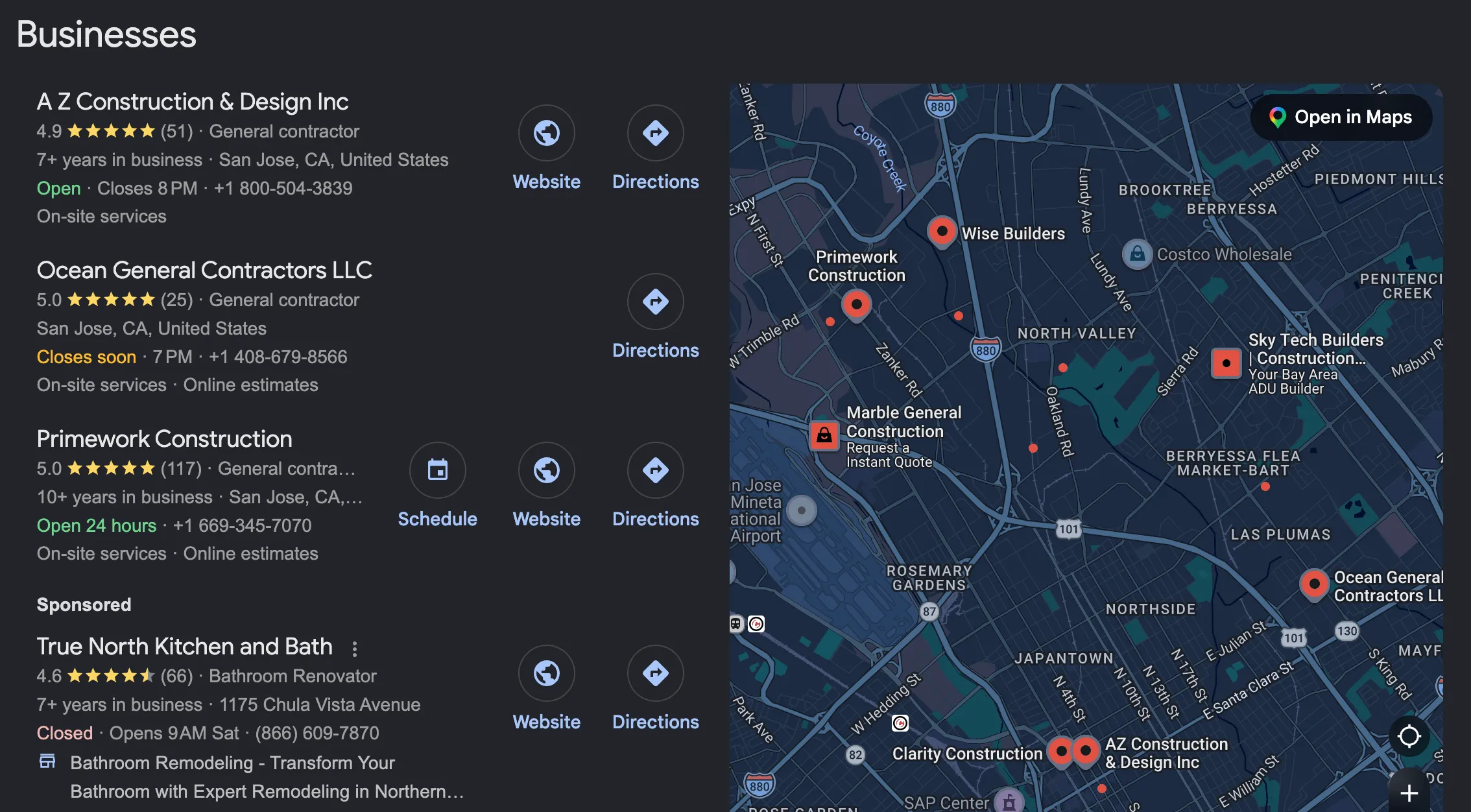
The map pack for “general contractors in San Jose, CA.” This is what a searcher sees first — before any organic result.
It is also ranked differently. The map pack runs on your Google Business Profile, and the things that move it — how close you are to the searcher, your reviews, your categories, real photos, a complete and accurate profile — are ones a smaller business can actually compete on. You do not need a decade of backlinks to land there.
So for “GC in [city],” the map pack is not a side quest. It is the goal. If you do one thing after reading this, claim and fully complete your Google Business Profile.
After that, the biggest lever is reviews. They carry real weight in the map pack, so ask every happy customer — make it easy with a direct link, texted to them while the job is still fresh. Reply to the ones you get, including the rare bad one. Google notices an active, engaged profile, and so does the homeowner reading it.
A strong profile helps beyond the map, too. It does not move the organic blue links directly the way backlinks and content do — but an active, well-reviewed, consistent profile is one more signal that you are a real, established local business, and that reputation quietly supports everything else.
The fundamentals still matter
None of this replaces the basics. A clear, fast, mobile-ready website is still the price of admission: the map pack and every other channel send people to your site, and a slow or confusing one loses them right there. Speed is a direct ranking factor, and clarity is what turns a visitor into a call — both covered in what your website has to do and what to cut from your contractor website.
The difference is that the fundamentals are the part you fully control, and you can fix them this month. Do them — not because they leapfrog the decade-old competitor, but because they are table stakes, and skipping them means nothing else you try gets a fair shot.
Play the game you can win
Two moves here, one idea: stop fighting the unwinnable fight.
First, the searches. “General contractor in [big city]” is a knife fight you will not win this year. But more specific searches — a particular service, a particular neighborhood, a particular kind of project — have far less competition, and the people typing them are often closer to actually hiring. Win the specific searches first.
Second, the links. You are not going to get a national newspaper to link to you, and you do not need one to. You need local, real links: your suppliers, the trade associations you belong to, the local team you sponsor, the chamber of commerce, a local news story. Each one is a genuine vote, and they add up.
Genuinely useful content
The article you are reading right now is an example of this. Pages that honestly help the person searching earn their ranking slowly and tend to keep it. It is the slowest lever and the most durable one.
The honest summary
Getting to the top of a competitive search is a multi-year project, and anyone who tells you otherwise is selling something. The decade-old competitor’s head start does not close quickly.
But the #1 organic result is not the only prize, and often not even the best one. The map pack, your reviews, the specific searches, the steady useful content — those are winnable, this year, by you. Do the real work, in the right places, and the phone does start to ring.
It just does not happen the way the checklist promised.