
WordPress, Wix, or Squarespace — which one ranks best on Google?

The platform you build your website on is not what decides whether you rank. What actually moves SEO and AI search results — and what Google has said directly about CMS choice.
Every few weeks someone asks a version of the same question. Which builder is best for SEO — WordPress, Wix, Squarespace? What about ChatGPT and the AI search results, does one of them work better for those?
It is a reasonable question. It is also the wrong one.
The platform you build on is not what decides whether your site ranks. It is one of the smaller factors — often a non-factor — sitting underneath a stack of much bigger ones. Picking the “SEO platform” and expecting rankings to follow is a little like picking a good oven and expecting to be a good cook.
Google has said this directly
You do not have to take our word for it. In 2022, Google’s John Mueller put it plainly: “As far as I know, our search systems don’t look for any particular content management system to treat it differently.” Google’s systems, he said, do not focus on how the page was created — they focus on the final result.
Translated: a WordPress page, a Wix page, a Squarespace page, and a hand-coded page all show up to Google as the same thing — a URL with some HTML on it. The judging happens on what the page contains and how it behaves, not the badge on the back of the engine.
The AI search engines — ChatGPT search, Google’s AI Overviews, Perplexity — work the same way. They read the open web, mostly the same pages Google is already crawling. There is no “Wix penalty” or “WordPress bonus.” They cite the sources that look authoritative and answer the question well.
So what actually decides where you rank?
A few things, and none of them are which builder you logged into.
- Authority. Other reputable sites linking to you. Years of consistent reviews. Real mentions across the web. On any competitive search, this is the single biggest factor — covered at length in the hard truth about ranking on Google. The established player is not ranking above you because their site is better. They are ranking above you because of trust accumulated over years.
- Speed and stability. How fast pages load, and how stable they are while loading. Google measures this directly.
- Structure. A clear sitemap, clean URLs, sensible headings, working internal links — the things that let a crawler, and a reader, make sense of the site.
- Content that genuinely answers the question. Pages a real person would find useful, written for the search the visitor actually typed.
- A complete, accurate Google Business Profile. For anything local, this is half the game.
- Mobile experience. Most visitors are on a phone, and Google indexes the mobile version of your site first.
Notice what is not on that list.
Where the platform can hurt you — but not the way you think
A platform does not give you SEO. It can take some away, though, if it is sloppy. Some builders ship bloated pages that load slowly. Some make it awkward to control titles, meta descriptions, image alt text, or URL slugs. Some inject scripts that drag down page speed.
These are real and worth checking before committing to a platform. But notice what they are: ways a builder can fail at the basics. The ceiling is the same for all of them. A well-tuned WordPress site and a well-tuned Wix site and a well-coded custom site can all rank — and equally, a sloppy build on any of them will struggle.
The thing that matters is whether the site that comes out the other end is fast, clear, structured, and worth linking to. That is determined by the person building it, far more than the tool.
How to check your own site
You do not have to take anyone’s word for how your site is doing on the basics. Google ships a free tool called Lighthouse that scores any page on performance, SEO, accessibility, and best practices, and it runs right inside Chrome.
In Chrome: right-click any page → Inspect → open the Lighthouse tab → Analyze page load. A minute later you get a report like this.
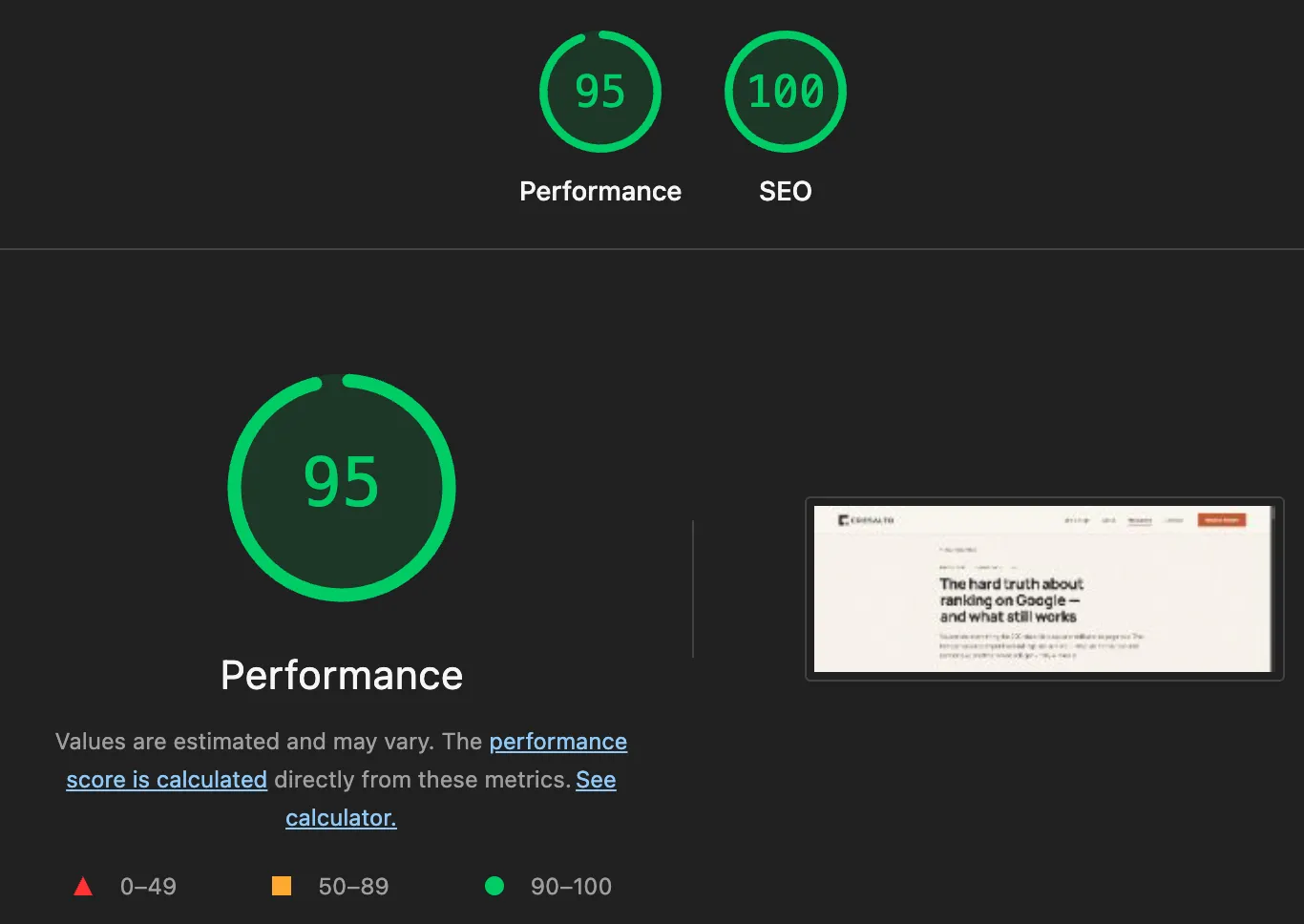
A Lighthouse report on the hard truth about ranking — 95 Performance, 100 SEO.
A green score (90+) on both means the page is clearing the technical bar. Anything orange or red is something the platform — or whoever built the site — is leaving on the table. Run it on your homepage and a couple of inner pages. In two minutes you will know whether the basics are handled, no agency required.
The AI search angle
The same logic applies to AI search, with one extra wrinkle.
AI tools synthesize answers from sources they consider trustworthy. The exact URLs they cite are not always Google’s top results — a November 2025 Search Engine Journal analysis found ChatGPT’s citations overlap with Google’s top 10 only about 10–15% of the time, Perplexity’s 25–30%. But the signal driving both is the same: authority and trust. AI tools lean even harder on already-established sources than Google does (Wikipedia alone accounts for roughly half of ChatGPT’s most cited domains), so earning a citation looks a lot like earning a ranking. There is no separate “AI SEO platform.” The fundamentals are still the fundamentals.
What helps a little extra: writing in a way that directly answers a question, so a model can lift a clean answer out of your page; being clear about who you are and what you do; and having enough of a footprint elsewhere on the web that the AI can actually place you. None of that is a function of your CMS.
The right question to ask about a platform
The platform question is not unimportant — it is just a different question. It is about building, maintaining, and not boxing yourself in — not about ranking.
Useful things to ask:
- Will this stay fast as the site grows?
- Can I control titles, meta descriptions, headings, image alt text, and URL structure?
- Can I add a page, a project, or a blog post without paying someone?
- If I ever want to move, can I take my content with me?
- Does it lock me into themes or page builders that get slow and dated?
Pick the platform that fits how the site will actually be maintained. Then put the energy that is left into the things that actually move rankings: the content, the speed, the structure, the reviews, the profile, and the slow patient work of becoming a site other people want to link to.
That is the real answer. There is no platform that shortcuts it — and there is no platform that prevents it either.
Common questions
Why isn’t my Wix site ranking on Google?
Almost never because it is on Wix. Ranking is decided by authority — other reputable sites linking to and mentioning you — along with content that answers the search, speed, structure, and a complete Google Business Profile. A Wix site with those handled outranks a WordPress site without them every time. If your site is not ranking, the platform is the last place to look; start with the hard truth about ranking on Google.
Does Google rank Wix sites lower than WordPress?
No. Google’s John Mueller has said plainly that its search systems do not look for a particular content management system or treat it differently. A Wix page, a WordPress page, and a hand-coded page all reach Google as the same thing — a URL with some HTML on it — judged on the result, not the tool that made it.
Which website platform is best for SEO?
There isn’t one, because the platform is not what ranks you. Any of the major builders can rank well or rank badly depending on how the site is built and what stands behind it. Choose the platform that fits how you will actually maintain the site — then put your energy into content, speed, structure, and reviews.